Understanding Free vs. Total Testosterone: What Your Results Mean
Could a normal total testosterone result still leave important questions unanswered? That’s why understanding free vs total testosterone matters: total measures the overall amount in your blood, while free measures the portion that isn’t bound to proteins. Neither number tells the whole story on its own.
If your lab report shows both values, or flags one as high or low, it’s understandable to wonder which result matters more. The answer depends on how the numbers fit together, your symptoms, and your health context, not on a single value viewed in isolation.
This guide explains what free and total testosterone measure, how binding proteins and other factors can influence your results, and why testing conditions matter. You’ll also find questions to discuss with a clinician. Summit Rejuvenation combines comprehensive bloodwork analysis with personalized telehealth consultations to support a clinician-guided review of your results in context.
Table of Contents
Free vs. total testosterone: what each blood test measures
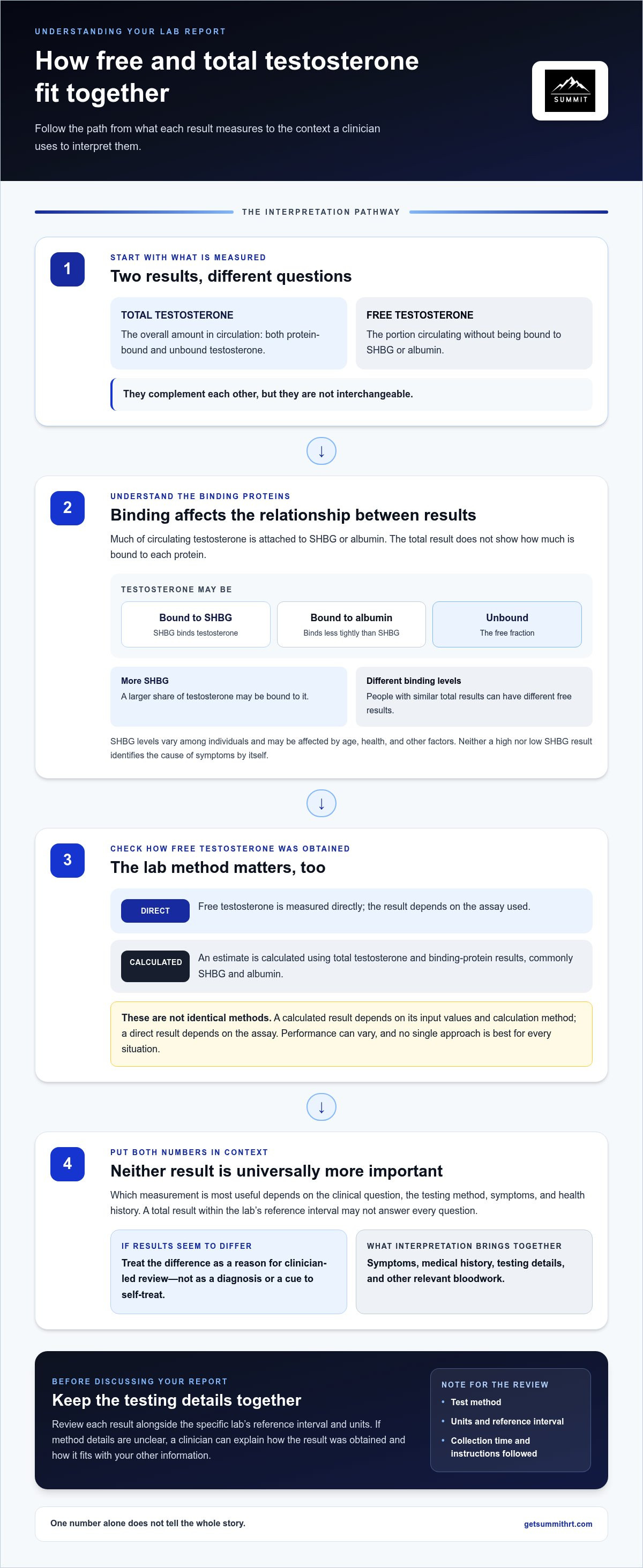
Total testosterone includes testosterone bound to proteins and testosterone that is unbound. Free testosterone measures only the unbound portion. The results answer different questions: total estimates the overall amount in circulation, while free focuses on the fraction not attached to carrier proteins.
Imagine total testosterone as all the water in a pool, with free testosterone as one part of that water. The analogy has limits: testosterone isn’t stored in a separate section of your blood, and free testosterone is a measured fraction, not a physically separate pool. For background on testosterone and its biological roles, see this overview.
What does total testosterone include?
Total testosterone measures bound and unbound testosterone circulating in the blood. Much of it is attached to sex hormone-binding globulin (SHBG) or albumin, the main proteins that bind testosterone. The total result therefore reflects more than the unbound fraction alone.
Laboratories may use different testing methods and reference intervals, so read your result alongside the range and units on that specific report. There isn’t one cutoff that applies to every person or every lab. A result outside the listed range is a reason to discuss it in context, not a diagnosis by itself.
What counts as free testosterone?
Free testosterone is the portion circulating without being bound to SHBG or albumin. Because it excludes the protein-bound portion, it provides different information from total testosterone. The results can complement each other, but they aren’t interchangeable.
Total testosterone measures bound and unbound testosterone in circulation; free testosterone measures only the unbound portion.
Two people with similar total testosterone results may have different free testosterone results. The balance between bound and unbound forms matters, and the measured value can also depend on the laboratory method. A free result isn’t automatically a more complete answer, just as a total result isn’t the whole story.
Neither value alone establishes a hormone disorder or determines whether treatment is appropriate. Clinicians interpret results alongside symptoms, medical history, testing details, and other relevant bloodwork. Understanding free vs total testosterone is a useful starting point for reading your report; a clinician-guided review helps put each number in perspective.
How SHBG and albumin change the relationship between free and total testosterone
Your total testosterone result doesn’t show how much testosterone is bound to each protein. SHBG and albumin bind testosterone in the blood, affecting how much remains unbound. As a result, two people with similar total testosterone levels can have different free testosterone results if their binding-protein levels differ.
For example, if one person has more SHBG, a larger share of testosterone may be bound to it. Another person with the same total level but less SHBG may have a different unbound fraction. This is why understanding free vs total testosterone means considering how the measurements relate, not comparing one number in isolation.
Why sex hormone-binding globulin matters
SHBG binds testosterone and can influence the free fraction reflected in a test result. Its level varies among individuals and may be affected by age, health, and other factors. Albumin also binds testosterone, but less tightly than SHBG. Neither a high nor low SHBG result identifies the cause of symptoms by itself. A clinician interprets it alongside other results and personal health information.
MedlinePlus explains different testosterone measurements and what they can indicate in its Testosterone Levels Test overview. It can help explain why a report may include more than one value, but your own results still need individual interpretation.
Measured and calculated free testosterone are not identical methods
A laboratory may measure free testosterone directly or calculate an estimate using total testosterone and binding-protein results, commonly SHBG and albumin. A calculated result depends on the input values and calculation method; a direct measurement depends on the assay used. These methods aren’t interchangeable labels for precisely the same process, and performance can vary. No single approach is best for every situation.
Check your report for the test method, units, and reference interval. If those details aren’t clear, a clinician can explain how the lab arrived at the result and how it fits with your total testosterone and symptoms. Summit Rejuvenation’s comprehensive bloodwork analysis and personalized telehealth consultations bring these details together for a clinician-guided evaluation. Explore hormone health support to discuss your results in context, not to assume that a particular result calls for treatment.
Which result matters more: free or total testosterone?
Neither result is universally more important. Total testosterone shows the overall amount in circulation, while free testosterone adds information about the unbound fraction. Which measurement is most useful depends on the clinical question, the testing method, and the person’s symptoms and health history.
A total result within the laboratory’s reference interval may not answer every question, particularly if binding-protein levels affect how testosterone is distributed. SHBG binds testosterone, so changes in SHBG can influence the relationship between total and free results. The University of Florida’s overview of Sex Hormone Binding Globulin (SHBG) explains how SHBG and albumin bind testosterone.
This comparison is educational, not diagnostic. A clinician interprets results using the laboratory’s method and reference interval, along with symptoms, medical history, and other relevant information.
When total testosterone may not tell the whole story
If SHBG is higher or lower than expected, a total result may not fully reflect the free fraction. That doesn’t make the total result meaningless; it means its context matters. Symptoms and medical history help shape the clinical picture, while repeat results can help determine whether an initial finding is consistent. Symptoms alone don’t confirm low testosterone or establish that treatment is needed.
When free testosterone adds useful context
A clinician may consider free testosterone when symptoms, total testosterone, or binding-protein results leave questions unresolved. It adds another piece of evidence, not a stand-alone diagnosis. Understanding free vs total testosterone means looking at how each result contributes to an overall evaluation, rather than choosing a winner.
Total and free testosterone aren’t competing answers; interpreted together, they can provide a more useful picture than either result ranked on its own. A clinician can determine whether both measurements are relevant and how they fit with repeat testing and your broader health history.
How to prepare for testosterone testing and read your report
A few details can make a lab report easier to discuss. Follow the instructions provided for your test and note when the sample was collected. Then review the results with a clinician alongside your symptoms, health history, and other relevant labs. Understanding free vs total testosterone is easier when you look beyond a flagged result and consider how and when it was measured.
Testosterone levels can vary during the day. For men being evaluated for possible low testosterone, clinical guidance generally favors morning testing, often between 7 a.m. and 11 a.m. A clinician may recommend a second morning measurement before drawing conclusions. Follow the instructions for your specific test, and let your clinician decide whether repeat testing is appropriate for your situation.
What details to note before discussing your results
Keep the report handy and record the test date and collection time. Check the units and the laboratory-specific reference interval printed beside each result. Reference ranges can differ between labs, so avoid comparing your number with an online range that uses different units or a different testing method.
Bring a concise record of relevant symptoms, medications, supplements, and health history. Don’t stop prescribed medication or change your routine to try to alter a result. If you’re unsure whether a factor could affect testing, discuss it with your clinician rather than making changes on your own.
Questions to ask about free and total testosterone
Clear questions can help turn confusing numbers into a useful conversation. Consider asking:
Which methods were used to measure or calculate my free and total testosterone, and are there any limitations I should understand?
How do the units and reference intervals on this report apply to my results?
Could SHBG or other relevant bloodwork affect how these values are interpreted?
How do my symptoms and health history fit with the lab findings, and would repeat testing add useful information?
A comprehensive bloodwork review can place testosterone results alongside relevant health information, rather than treating one number as the whole picture. Summit Rejuvenation supports lab review through comprehensive bloodwork analysis and personalized telehealth consultations, with clinician-guided evaluation as a measured next step.
Explore bloodwork-supported hormone care to discuss your results in context.
Next steps when free and total testosterone results differ
Results that appear inconsistent can be unsettling, but they call for context, not an immediate conclusion. A higher-than-expected free result alongside a total result in range, or the reverse, doesn’t by itself confirm a hormone disorder or mean you should start treatment. Don’t interpret the difference through one number or make treatment changes on your own.
How a clinician can put both results in context
A clinician can review the full report, including the testing method, units, reference intervals, and any binding-protein results, then consider them alongside your symptoms and health history. They may also review medications and other relevant bloodwork. Whether additional assessment or repeat testing makes sense depends on your individual situation. If you’re exploring testosterone therapy, discuss your results and questions with a clinician.
Bring questions about what each result measures and whether the two values were obtained or calculated using methods that can be interpreted together. A thorough review can help clarify what is known, what remains uncertain, and whether another step is appropriate.
Why a lab result alone should not determine treatment
Laboratory values matter, but they’re only one part of a clinical evaluation. Symptoms, medical history, testing details, and relevant health factors all help shape the discussion. Symptoms alone don’t establish a diagnosis, and a particular number doesn’t guarantee that treatment is appropriate.
If treatment is being considered, talk through potential benefits, risks, monitoring, and your personal goals with a qualified clinician. The aim is an informed decision based on your circumstances, not a reflex response to a flagged result. Understanding free vs total testosterone can help you ask more focused questions, but it doesn’t replace individualized assessment.
Summit Rejuvenation provides hormone therapy supported by comprehensive bloodwork analysis and personalized telehealth consultations. If your results differ, a clinician-guided review can help put them in context and determine a measured next step. Explore Summit Rejuvenation’s personalized hormone-care approach when you’re ready to discuss your results and goals.
Turn your testosterone results into a clearer next step
Total testosterone reflects bound and unbound testosterone, while free testosterone measures the unbound portion. Neither result is universally more important, and differences between them need context, including binding proteins, symptoms, testing details, and health history.
Understanding free vs total testosterone can help you read your report and ask more informed questions, but a lab value alone doesn’t diagnose a hormone disorder or determine treatment. A clinician can review the results, consider whether further assessment is appropriate, and discuss options in light of your personal goals.
Summit Rejuvenation supports hormone care with comprehensive bloodwork analysis and personalized telehealth consultations. Explore personalized, bloodwork-supported hormone care to discuss your results and goals with clinician guidance.
Frequently Asked Questions
What is the difference between free and total testosterone?
Total testosterone measures testosterone in its bound and unbound forms in the blood, while free testosterone measures the portion not bound to carrier proteins. The results describe related but different aspects of testosterone, so they aren’t interchangeable. A clinician considers the values alongside symptoms, health history, laboratory methods, and the reference intervals on your report. Neither result, by itself, provides a complete diagnosis.
Is free testosterone more important than total testosterone?
No, free testosterone isn’t universally more important than total testosterone. Total provides a broad measurement, while free adds information about the unbound fraction. Binding proteins, symptoms, testing methods, and the reason for testing all affect how each result is understood. A clinician can determine whether one or both measurements are useful in a particular evaluation. Don’t rank the results or make treatment decisions based on a number alone.
Can total testosterone be normal while free testosterone is low?
Yes, the results can differ because binding proteins influence how testosterone is distributed between bound and unbound forms. The significance of that pattern depends on the actual values, units, laboratory methods, reference intervals, and clinical context. A clinician may review related results or consider further assessment. A total result within the lab’s range doesn’t necessarily explain every symptom, but a difference alone doesn’t establish that a hormone disorder is present.
How is free testosterone measured?
Free testosterone may be measured directly or calculated from other results, such as total testosterone and binding-protein measurements. These approaches use different methods and aren’t automatically interchangeable; laboratory methods can also vary in performance. Check your report for the method, units, and reference interval. If you’re unsure how the value was obtained, ask the clinician reviewing your results to explain how those details affect interpretation.
When should free and total testosterone be tested?
A clinician may consider testing when evaluating symptoms or a health concern, but the appropriate tests and timing depend on the individual. Collection time, repeat testing, medications, and the laboratory’s instructions may all matter. Follow the instructions provided for your test and discuss its purpose with your clinician. This article can’t determine whether testing is appropriate for you; a clinician can assess your situation and recommend a suitable approach.
What does it mean if free and total testosterone results disagree?
Discordant results don’t automatically indicate a disease or mean treatment is needed. Binding proteins, test methods, reference intervals, and individual health factors may all help explain the pattern. A clinician can review the complete report alongside your symptoms and relevant history, then decide whether more assessment is useful. Avoid trying to correct an isolated result with supplements or medication without medical guidance.
Can I diagnose low testosterone from one test result?
No, one test result alone can’t establish a diagnosis. Understanding free vs total testosterone helps you see what the measurements describe, but interpretation also depends on symptoms, clinical assessment, the laboratory method, reference interval, and reason for testing. A clinician may recommend reviewing or repeating tests based on your circumstances. Don’t start, stop, or adjust hormone treatment based only on an online explanation or a flagged lab value.


Comments