Tesamorelin for Visceral Fat Reduction: Evidence, Safety, and Treatment Decisions in 2026
Could a treatment reduce deep abdominal fat without changing the pinchable layer you see and feel? That distinction is central to understanding tesamorelin for visceral fat reduction. Tesamorelin has FDA approval for reducing excess visceral abdominal fat in adults with HIV-associated lipodystrophy, not for general weight loss or cosmetic fat reduction. Its evidence and suitability depend on that specific clinical context, not broad promises of a flatter stomach.
If you’re trying to make sense of belly fat, it’s understandable to wonder whether tesamorelin can help, what results to expect, and what risks come with treatment. It works differently from appetite-focused weight-loss medicines, and a change in visceral fat doesn’t necessarily mean lower body weight or less visible subcutaneous fat.
This article explains how tesamorelin works, what research can and can’t tell us about its effects, and why results may not last after treatment stops. You’ll also learn about key safety considerations, including blood-glucose monitoring, and what to discuss during a clinician-led evaluation. The goal is clear, realistic information to help you weigh supervised treatment planning against generalized claims.
Table of Contents
What does tesamorelin for visceral fat reduction actually mean?
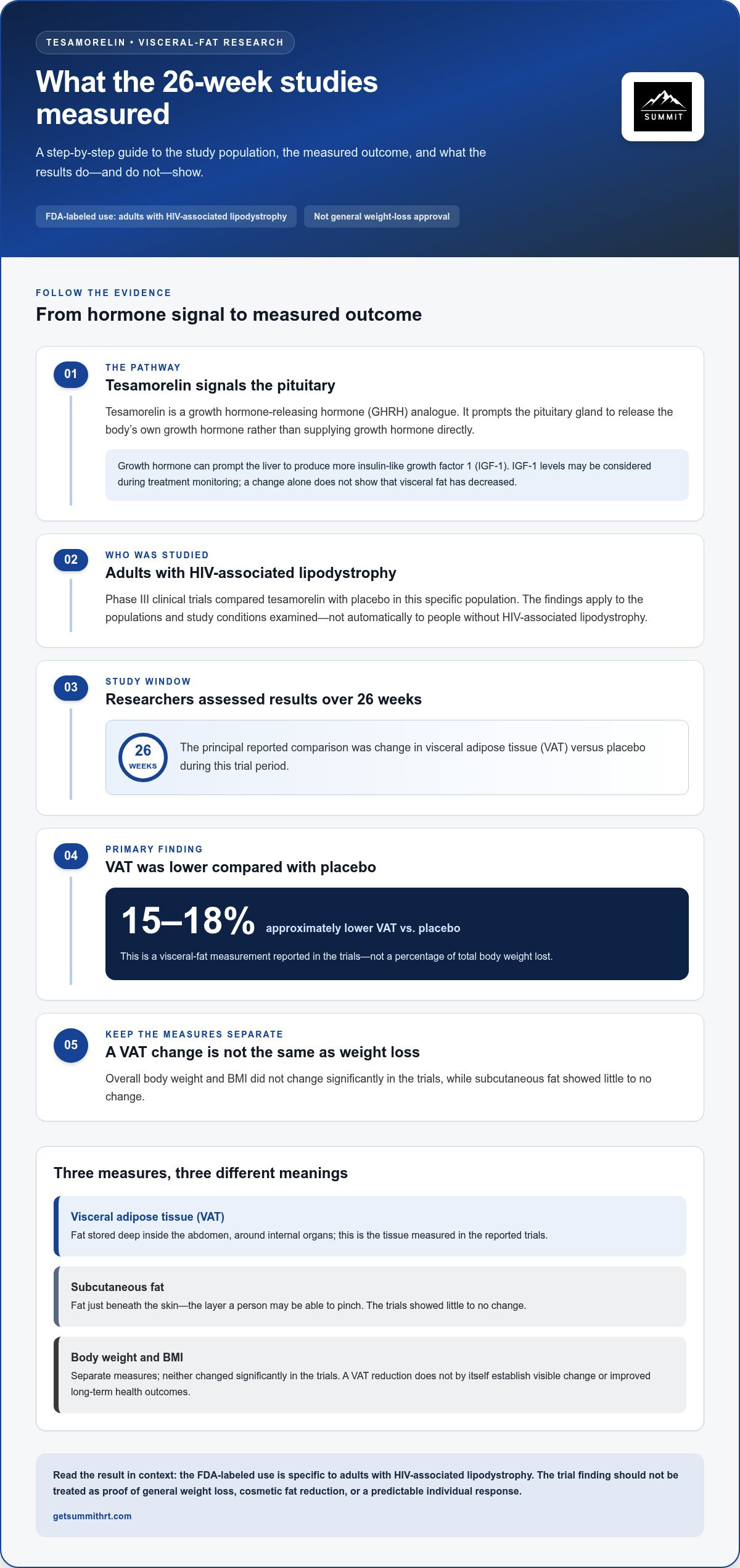
The phrase can sound like a promise to shrink any abdominal fat, but that’s broader than the evidence and approved use support. Tesamorelin is a growth hormone-releasing hormone (GHRH) analogue. It prompts the pituitary gland to release the body’s own growth hormone rather than supplying growth hormone directly. For a general overview of the medicine and its uses, see Tesamorelin.
What is visceral fat, and how is it different from belly fat?
Visceral adipose tissue is fat stored deep inside the abdomen, around internal organs. Subcutaneous fat sits just beneath the skin and is the layer a person may be able to pinch. Both can contribute to abdominal size, but they are different tissues. Total body weight is different again: it reflects the combined weight of fat, muscle, bone, organs, and fluid.
Appearance alone can’t show how much visceral fat someone has. A prominent abdomen isn’t a reliable way to distinguish deep abdominal fat from subcutaneous fat or other causes of abdominal size. This matters because research measuring visceral adipose tissue doesn’t automatically show that a treatment will change visible belly fat, body weight, or overall health outcomes.
What is tesamorelin approved to treat?
In the United States, FDA labeling specifies tesamorelin to reduce excess abdominal fat in adults with HIV-associated lipodystrophy. That is a defined medical indication, not approval for general weight loss, cosmetic fat reduction, or treating visceral fat in people without HIV-associated lipodystrophy. The indication describes the population and treatment goal; it doesn’t mean every person in that group is an appropriate candidate.
Use outside the labeled indication is considered off-label. Online claims that present tesamorelin as a broadly proven solution for stubborn belly fat go beyond what FDA approval establishes. Off-label prescribing is a clinical decision, not evidence that a treatment is suitable for everyone or will produce a particular result.
Keep the distinction clear: tesamorelin’s FDA-labeled use is specific, and it shouldn’t be treated as a shortcut for general weight management. Approval also doesn’t guarantee an individual response or establish that treatment will prevent complications or improve long-term health outcomes. A clinician can interpret the indication alongside your medical history, goals, and relevant test results before discussing whether a treatment approach makes sense.
How tesamorelin works, and what visceral-fat research can show
Tesamorelin acts on a hormone signal, not directly on fat cells. It is a synthetic analogue of growth hormone-releasing hormone (GHRH), which signals the pituitary gland to release the body’s own growth hormone. That pathway helps explain why studies examine changes in visceral adipose tissue, but it can’t predict how any one person will respond.
How does tesamorelin affect the growth hormone pathway?
After tesamorelin stimulates growth hormone release, growth hormone can prompt the liver to produce more insulin-like growth factor 1 (IGF-1). IGF-1 is a hormone involved in growth and other body processes. Clinicians may consider IGF-1 levels during treatment monitoring because they reflect activity in this pathway. A change in IGF-1, however, doesn’t by itself show that visceral fat has decreased or that treatment is appropriate. For additional patient-focused context, see Tesamorelin patient information.
What do clinical studies measure when they report fat reduction?
In phase III clinical trials involving adults with HIV-associated lipodystrophy, researchers compared tesamorelin with placebo and measured visceral adipose tissue (VAT). Over 26 weeks, tesamorelin reduced VAT by approximately 15% to 18% compared with placebo. This finding applies to the populations and study conditions examined; it shouldn’t be assumed to predict results in people without HIV-associated lipodystrophy.
VAT is assessed as a body-composition outcome rather than inferred from a change on the scale. Overall body weight and BMI did not change significantly in the trials, while subcutaneous fat showed little to no change. A measured reduction in deep abdominal fat therefore isn’t the same as losing a particular amount of weight, seeing a smaller waist, or proving improved long-term health.
A visceral-fat measurement can show a change in the amount of deep abdominal fat assessed, but it can’t alone establish visible change, overall weight loss, or better health outcomes. Keep that distinction in mind when weighing claims about tesamorelin for visceral fat reduction. If you’re considering whether the evidence applies to your circumstances, a clinician-led review can put your goals, medical history, and relevant lab results in context. Explore a clinician-led evaluation.
Tesamorelin benefits, limits, and risks: how to compare the evidence
Evidence is easiest to interpret when the measured outcome, studied population, and treatment risks stay in view. The FDA-approved indication is narrow, and a change in visceral fat should not be mistaken for general weight loss or proof of better cardiovascular health.
What benefits are supported, and what remains uncertain?
Clinical trials support a reduction in visceral adipose tissue in adults with HIV-associated lipodystrophy. That finding doesn’t establish that tesamorelin will reduce abdominal fat in everyone, change pinchable subcutaneous fat, or produce a meaningful change in scale weight or appearance. Nor does a VAT reduction by itself prove that treatment prevents heart attacks, improves cardiovascular risk, or extends life. Those are separate outcomes that require their own evidence.
Use the comparison below to distinguish what the evidence and labeling address from broader claims about tesamorelin for visceral fat reduction.
Which risks and monitoring questions matter?
The current FDA prescribing information contraindicates tesamorelin in people with active malignancy, disruption of the hypothalamic-pituitary axis, or pregnancy. A history of malignancy calls for careful consideration; clinicians also weigh the label’s warning about malignancy and monitor as appropriate. Other reported effects include joint pain, tingling sensations, and hypersensitivity reactions. This list isn’t a personal risk assessment.
Before making treatment decisions, review your medical history, medications, glucose-related risks, and any prior pituitary or cancer history with a qualified clinician. Ask what monitoring is appropriate, including whether glucose and IGF-1 should be followed in your situation. Bloodwork can inform that discussion, but it doesn’t establish that tesamorelin is suitable or make off-label use equivalent to an FDA-approved indication.
How to assess whether tesamorelin fits your situation
A thoughtful discussion starts with your health context, not a search term or a promise of targeted fat loss. Tesamorelin’s labeled indication and the population studied matter, so a clinician needs to consider your diagnosis, goals, medical history, and potential risks together.
What should a clinician review before discussing treatment?
Bring a current medication list and a summary of relevant health conditions, past diagnoses, and treatment history. Be specific about what you hope to change. Reducing a measured visceral-fat level, losing overall weight, and changing your appearance are different goals, and the available evidence may not address them in the same way.
Use this four-step framework to organize the conversation:
Clarify your goal: Describe the outcome you’re seeking and how you hope to measure it.
Review your history: Discuss diagnoses, current and past medications, and any relevant pituitary, cancer, pregnancy, or glucose-related concerns.
Assess relevant labs: Comprehensive bloodwork can help inform an individualized medical review. Results don’t prove eligibility or establish that tesamorelin is appropriate.
Weigh options and follow-up: Discuss alternatives, possible risks, monitoring expectations, and how a clinician would evaluate response over time.
A clinician should compare your situation with the current prescribing information, including the labeled indication, contraindications, warnings, and precautions. That review should account for your personal risk profile rather than rely on a checklist that claims to determine treatment suitability.
What questions help compare tesamorelin with other approaches?
Clear questions can help you distinguish a supervised medical decision from generalized marketing claims. Consider asking:
How does this option relate to my diagnosis, and how closely does the research population match my circumstances?
What outcome would treatment aim to change, and how would we assess it without treating scale weight or appearance as a substitute for visceral-fat measurements?
Which risks and side effects are most relevant to my health history, and what monitoring would be appropriate?
What other approaches fit my goals, and what are their expected benefits and limitations?
For broader context on clinician-guided peptide discussions and individualized weight-management care, read Summit’s peptides for weight loss guide. If you’re ready to discuss your goals, medical history, and lab results in a clinician-led setting, explore a telehealth consultation.
Plan a clinician-led next step with Summit Rejuvenation
A sound next step is to confirm what tesamorelin is intended to treat, weigh the evidence and risks, and discuss how your health history shapes the decision. The question isn’t simply whether tesamorelin for visceral fat reduction is being discussed online. It’s whether the available evidence and treatment considerations fit your individual clinical context.
What happens during a personalized medical evaluation?
At Summit Rejuvenation, a telehealth consultation gives you space to discuss your health goals, relevant diagnoses, medications, and concerns with a clinician. Comprehensive bloodwork can add useful context to that conversation. Neither a consultation nor lab results automatically establish that a specific medication is appropriate; they support a fuller, individualized review.
Treatment planning should account for potential benefits and limitations alongside safety considerations and the current prescribing information. You can discuss what outcome matters to you, what monitoring may be relevant, and what follow-up would help assess the plan. The goal is not a universal protocol, but a decision informed by your circumstances.
How can readers make an informed decision after the consultation?
Before settling on a plan, make sure you understand the clinical rationale, what the proposed approach is meant to address, and what it can’t promise. Clarify any recommended monitoring, how response would be reviewed, and what would prompt a change in direction. A medically informed plan may or may not include tesamorelin.
For additional context on peptides and how they fit into broader health discussions, explore Summit’s peptide therapy guide. The aim is clarity, thoughtful follow-up, and care shaped around your health, not a guaranteed fat-loss outcome.
Explore personalized medical care with Summit Rejuvenation through a clinician-led telehealth consultation, comprehensive bloodwork, and personalized treatment planning.
Make your next step an informed one
Tesamorelin has a specific FDA-approved use, and evidence of reduced visceral fat in that setting doesn’t establish it as a general weight-loss treatment or guarantee an individual result. Keep the distinction between visceral fat, visible abdominal fat, and overall body weight in mind as you weigh treatment claims.
The best next step is a clinician-led discussion of your goals, health history, potential risks, and what monitoring may involve. Comprehensive bloodwork can help inform personalized planning, but it doesn’t determine suitability on its own. A telehealth consultation can bring those details together and support a considered conversation about options.
At Summit Rejuvenation, personalized medical planning and telehealth consultations serve patients nationally. You don’t have to make sense of broad claims alone. Explore personalized medical care with Summit Rejuvenation and take an informed step toward care that reflects your individual health needs.
Frequently Asked Questions
Is tesamorelin FDA-approved for visceral fat reduction?
Yes, but its FDA-labeled use is specific: reducing excess abdominal fat in adults with HIV-associated lipodystrophy. That approval doesn’t establish tesamorelin as a general weight-loss treatment or mean it’s suitable for everyone with visceral fat. Whether the indication applies depends on a person’s diagnosis and clinical circumstances. Discuss your health history and treatment options with a qualified clinician rather than relying on broad online claims.
Can tesamorelin help people lose weight without HIV-associated lipodystrophy?
Evidence from adults with HIV-associated lipodystrophy shouldn’t be assumed to apply to people outside that studied population. Research has measured changes in visceral fat, which is not the same as overall weight loss. Use outside the FDA-labeled indication is off-label, and that alone doesn’t show it’s appropriate for an individual. A clinician should weigh the available evidence, personal risks, goals, and alternatives before any treatment decision.
How does tesamorelin affect visceral fat?
Tesamorelin is a growth hormone-releasing hormone analogue that signals the pituitary gland to release the body’s own growth hormone. Researchers have assessed changes in visceral adipose tissue in specific study populations. Those measurements don’t automatically demonstrate a lower number on the scale, a visible change in abdominal shape, or better long-term health outcomes. The phrase tesamorelin for visceral fat reduction should be understood in that evidence-specific context.
What are the main risks or side effects of tesamorelin?
Reported side effects include joint pain, fluid retention, injection-site reactions, and tingling sensations. FDA labeling also warns that tesamorelin may impair glucose control, so glucose-related risks require clinician review and monitoring. The medication is contraindicated in people with active malignancy, disruption of the hypothalamic-pituitary axis, or pregnancy. This overview can’t assess personal safety. Discuss your medical history with a clinician, and seek urgent care for severe or concerning symptoms.
Does tesamorelin reduce belly fat or overall body weight?
Studies have found reductions in visceral fat in adults with HIV-associated lipodystrophy, but that doesn’t promise visible belly-fat loss or a specific change on the scale. Visceral fat lies around abdominal organs; subcutaneous fat sits beneath the skin. They’re distinct measures. Trial findings in a defined population can’t predict an individual response, and a change in visceral-fat measurement alone doesn’t establish improved long-term health.
What should I discuss with a clinician before considering tesamorelin?
Discuss your diagnosis, treatment goals, medical history, current medications, relevant bloodwork, possible risks, and expected monitoring. Ask how closely the available evidence fits your circumstances and how a clinician would evaluate response over time. Comprehensive bloodwork can inform individualized planning, but it can’t establish eligibility by itself. An online article can help you prepare, but it can’t determine whether treatment is appropriate or replace a personalized medical consultation.


Comments