top of page

Summit Rejuvenation
Education

If you live in Wentzville, O'Fallon, St. Peters, or Cottleville, you've probably heard a coworker, neighbor, or family member mention GLP-1 medications. Maybe you've seen the ads, too. It's easy to come away thinking weight loss now means getting a prescription and waiting for the scale to move.

The reality is more involved, and that's a good thing. A medically supervised program is built around your labs, your health history, and regular check-ins, not just a medication. This guide explains what GLP-1 medications are, how a supervised program usually works at Summit Rejuvenation's St. Charles County offices, and the questions worth asking before you start anywhere.

What GLP-1 medications are, in plain language

GLP-1 stands for glucagon-like peptide-1, a hormone your gut releases after you eat. It helps signal fullness to your brain, slows how quickly your stomach empties, and plays a role in blood sugar control.

GLP-1 medications, such as semaglutide, are designed to act like that natural hormone. For many people, that means feeling satisfied with smaller portions and having fewer cravings between meals. Some medications in this family were first developed for type 2 diabetes, and certain ones are now also prescribed for weight management in adults who meet medical criteria.

A few things these medications are not:

  • They aren't right for everyone. Some people shouldn't take them because of their personal or family medical history, other medications, or other health conditions.

  • They aren't a shortcut around habits. Eating enough protein, staying active, and sleeping well still matter, and they matter even more when your appetite is lower.

  • They aren't side-effect free. Nausea, constipation, diarrhea, and other stomach issues are common, especially early on. Less common but more serious risks, including gallbladder problems and pancreatitis, are part of why medical supervision matters.

That's why the first step in a supervised program isn't a prescription. It's an evaluation.

Why weight can feel harder than it should

Plenty of people who look into medical weight loss have already done the "right" things. They've tracked calories, joined a gym, and cut out late-night snacks, and the results stalled anyway.

Weight is influenced by more than willpower. Hormones, thyroid function, blood sugar and insulin, sleep, stress, certain medications, and age-related changes can all play a part. For women, perimenopause and menopause can shift where and how the body stores weight. For men, low testosterone may be part of the picture.

None of that means something is "wrong" with you. It means a good program should look under the hood before recommending anything. You can read more about how hormones fit in on our medical weight loss page.

How a supervised program works at Summit

Every practice handles this a little differently, so it's fair to ask any clinic to walk you through its exact steps. Here's how it typically works at Summit Rejuvenation.

1. Comprehensive bloodwork

Your care starts with a lab panel drawn at a LabCorp location near you. For weight loss patients, that panel includes markers such as A1c, a comprehensive metabolic panel, lipids, thyroid markers, vitamin D, and a CBC, along with the hormone markers in Summit's standard panel.

Labs give your provider a baseline. They can point to issues that affect weight, like blood sugar or thyroid concerns, and they help show whether a particular medication makes sense for you.

2. A one-on-one review with a licensed provider

Once your results are in, you meet with a licensed provider, either in the office or by telehealth. Together you'll go over your labs, your health history, your current medications and supplements, and your goals.

This is the moment to be thorough. Mention past surgeries, any history of pancreatitis or gallbladder problems, thyroid conditions in your family, and anything else your provider should know. If a GLP-1 medication isn't appropriate for you, your provider will say so and talk through other parts of the program.

3. A personalized plan, if treatment is appropriate

If your provider decides a prescription is a good fit, they'll explain the options, how the medication is taken, what side effects to watch for, and how the dose may be adjusted over time. Medication, supplies, and instructions ship to your home.

4. Coaching that works alongside the medicine

Summit partners with 1st Phorm so weight loss patients get a coach and trainer, plus access to the 1st Phorm App for nutrition guidance, workouts, and accountability. This matters because a lower appetite can make it easy to under-eat protein or skip strength training, and both help you hold on to muscle while you lose fat.

5. Regular check-ins

Your provider keeps tabs on how you feel, any side effects, how nutrition and training are going, and whether your plan needs to change. Many check-ins can happen by telehealth, which helps if your schedule already revolves around I-70 or Highway 364 traffic.

Where to find us in St. Charles County

Summit has two offices in St. Charles County that offer medical weight loss.

Wentzville 1125 W Pearce Blvd, Wentzville, MO 63385 (636) 887-2999 Hours: Monday, Tuesday, and Thursday, 9 AM to 5 PM

The Wentzville office sits near the Wentzville Parkway interchange with I-70, which makes it practical for patients from Lake Saint Louis, O'Fallon, Foristell, New Melle, Wright City, and Troy. See the full details on our medical weight loss in Wentzville page.

Cottleville 5055 State Route N, Suite 102/103, Cottleville, MO 63304 (636) 244-0247 Hours: Monday through Friday, 9 AM to 5 PM

The Cottleville office is in the Cottleville Corners shopping center, just off Mid Rivers Mall Drive. It's convenient for St. Peters, O'Fallon, Weldon Spring, Dardenne Prairie, and St. Charles. The suite is shared with our sister business, Renu Medspa, so just mention Summit Rejuvenation when you call.

Prefer to stay closer to St. Louis County? Summit also has offices in Chesterfield and South County.

Questions to ask before starting any GLP-1 program

Whether you choose Summit or another clinic, these questions can help you compare your options:

  1. Are labs required before a prescription? A program that skips bloodwork is skipping important information.

  2. Who reviews my results and oversees my care? You should know you're working with a licensed provider, not just filling out an online form.

  3. How often are check-ins, and what happens if I have side effects? Ask who you contact and how quickly they respond.

  4. How is the dose adjusted? Doses are often increased gradually. Ask how that's decided for you.

  5. What support is there for nutrition and exercise? Medication works best as part of a bigger plan.

  6. What happens if I stop? Weight regain is possible after stopping. Ask how the program helps you build habits that last, and read our post on life after stopping semaglutide for more on that.

  7. What does the program cost, and what's included? Ask for a clear breakdown up front so there are no surprises.

Making the most of your first months

If you and your provider decide to move forward, a few habits can make the early weeks smoother:

  • Eat smaller meals and slow down. Stopping when you feel satisfied can help with nausea.

  • Prioritize protein. Build meals around a protein source to help protect muscle.

  • Drink water. Hydration helps with constipation and overall comfort.

  • Keep lifting. Strength training, even two or three short sessions a week, supports muscle and metabolism. Your 1st Phorm coach can help you plan it.

  • Track more than the scale. Energy, sleep, how your clothes fit, and lab changes over time all tell part of the story.

  • Report side effects early. Don't wait until your next scheduled check-in if something feels off.

Progress looks different for everyone. Your provider can help you set realistic expectations based on your own health picture.

Ready to talk it through?

If you've been wondering whether medical weight loss makes sense for you, the simplest next step is a conversation. Summit's approach is education first, sales second, so you'll understand your labs before you decide anything.

Call the Wentzville office at (636) 887-2999, the Cottleville office at (636) 244-0247, or visit Start Today to request a free consultation.

This article is for educational purposes only and isn't medical advice. GLP-1 medications aren't appropriate for everyone. Talk with a licensed healthcare provider about your own health, risks, and treatment options.

Reviewed by Summit Rejuvenation's licensed medical team.
Could a normal total testosterone result still leave important questions unanswered? That’s why understanding free vs total testosterone matters: total measures the overall amount in your blood, while free measures the portion that isn’t bound to proteins. Neither number tells the whole story on its own.


If your lab report shows both values, or flags one as high or low, it’s understandable to wonder which result matters more. The answer depends on how the numbers fit together, your symptoms, and your health context, not on a single value viewed in isolation.


This guide explains what free and total testosterone measure, how binding proteins and other factors can influence your results, and why testing conditions matter. You’ll also find questions to discuss with a clinician. Summit Rejuvenation combines comprehensive bloodwork analysis with personalized telehealth consultations to support a clinician-guided review of your results in context.


Table of Contents


Free vs. total testosterone: what each blood test measures


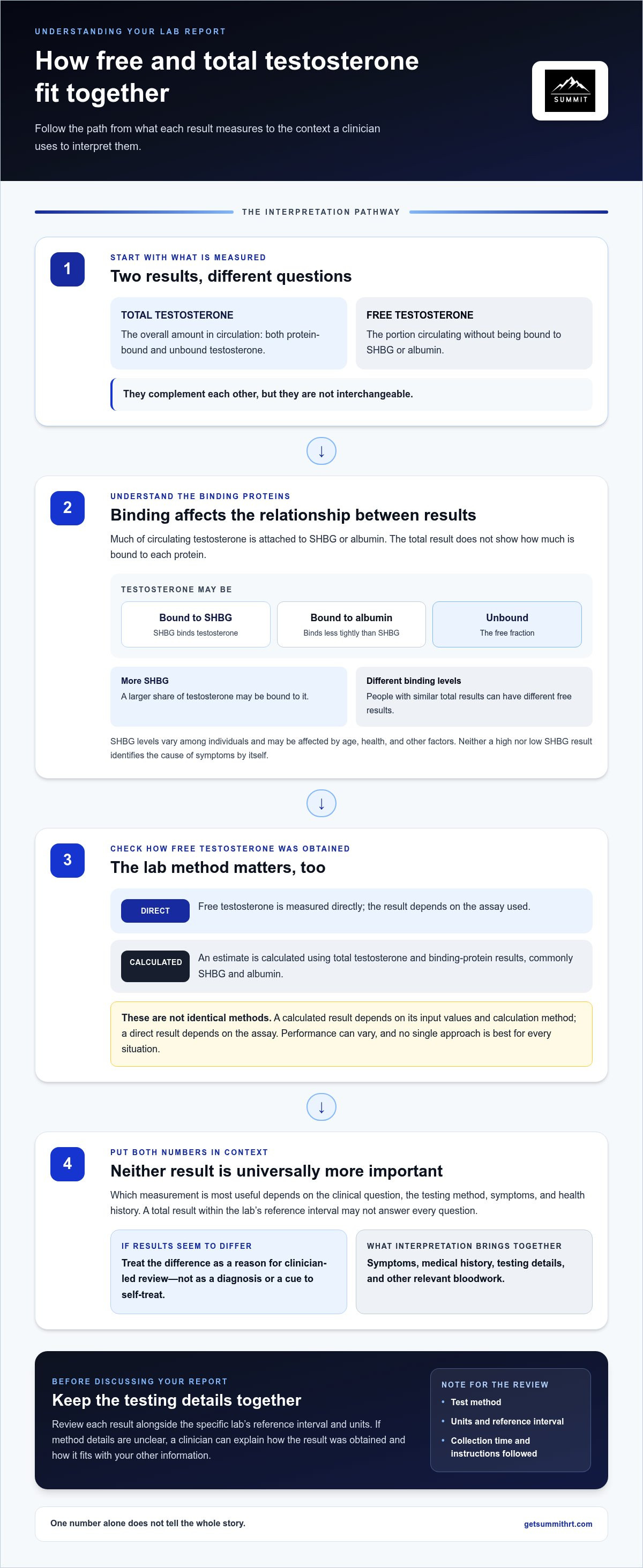
Total testosterone includes testosterone bound to proteins and testosterone that is unbound. Free testosterone measures only the unbound portion. The results answer different questions: total estimates the overall amount in circulation, while free focuses on the fraction not attached to carrier proteins.


Imagine total testosterone as all the water in a pool, with free testosterone as one part of that water. The analogy has limits: testosterone isn’t stored in a separate section of your blood, and free testosterone is a measured fraction, not a physically separate pool. For background on testosterone and its biological roles, see this overview.


What does total testosterone include?


Total testosterone measures bound and unbound testosterone circulating in the blood. Much of it is attached to sex hormone-binding globulin (SHBG) or albumin, the main proteins that bind testosterone. The total result therefore reflects more than the unbound fraction alone.


Laboratories may use different testing methods and reference intervals, so read your result alongside the range and units on that specific report. There isn’t one cutoff that applies to every person or every lab. A result outside the listed range is a reason to discuss it in context, not a diagnosis by itself.


What counts as free testosterone?


Free testosterone is the portion circulating without being bound to SHBG or albumin. Because it excludes the protein-bound portion, it provides different information from total testosterone. The results can complement each other, but they aren’t interchangeable.


Total testosterone measures bound and unbound testosterone in circulation; free testosterone measures only the unbound portion.


Two people with similar total testosterone results may have different free testosterone results. The balance between bound and unbound forms matters, and the measured value can also depend on the laboratory method. A free result isn’t automatically a more complete answer, just as a total result isn’t the whole story.


Neither value alone establishes a hormone disorder or determines whether treatment is appropriate. Clinicians interpret results alongside symptoms, medical history, testing details, and other relevant bloodwork. Understanding free vs total testosterone is a useful starting point for reading your report; a clinician-guided review helps put each number in perspective.


How SHBG and albumin change the relationship between free and total testosterone


Your total testosterone result doesn’t show how much testosterone is bound to each protein. SHBG and albumin bind testosterone in the blood, affecting how much remains unbound. As a result, two people with similar total testosterone levels can have different free testosterone results if their binding-protein levels differ.


For example, if one person has more SHBG, a larger share of testosterone may be bound to it. Another person with the same total level but less SHBG may have a different unbound fraction. This is why understanding free vs total testosterone means considering how the measurements relate, not comparing one number in isolation.


Why sex hormone-binding globulin matters


SHBG binds testosterone and can influence the free fraction reflected in a test result. Its level varies among individuals and may be affected by age, health, and other factors. Albumin also binds testosterone, but less tightly than SHBG. Neither a high nor low SHBG result identifies the cause of symptoms by itself. A clinician interprets it alongside other results and personal health information.


MedlinePlus explains different testosterone measurements and what they can indicate in its Testosterone Levels Test overview. It can help explain why a report may include more than one value, but your own results still need individual interpretation.


Measured and calculated free testosterone are not identical methods


A laboratory may measure free testosterone directly or calculate an estimate using total testosterone and binding-protein results, commonly SHBG and albumin. A calculated result depends on the input values and calculation method; a direct measurement depends on the assay used. These methods aren’t interchangeable labels for precisely the same process, and performance can vary. No single approach is best for every situation.


Check your report for the test method, units, and reference interval. If those details aren’t clear, a clinician can explain how the lab arrived at the result and how it fits with your total testosterone and symptoms. Summit Rejuvenation’s comprehensive bloodwork analysis and personalized telehealth consultations bring these details together for a clinician-guided evaluation. Explore hormone health support to discuss your results in context, not to assume that a particular result calls for treatment.


Which result matters more: free or total testosterone?


Neither result is universally more important. Total testosterone shows the overall amount in circulation, while free testosterone adds information about the unbound fraction. Which measurement is most useful depends on the clinical question, the testing method, and the person’s symptoms and health history.


A total result within the laboratory’s reference interval may not answer every question, particularly if binding-protein levels affect how testosterone is distributed. SHBG binds testosterone, so changes in SHBG can influence the relationship between total and free results. The University of Florida’s overview of Sex Hormone Binding Globulin (SHBG) explains how SHBG and albumin bind testosterone.


This comparison is educational, not diagnostic. A clinician interprets results using the laboratory’s method and reference interval, along with symptoms, medical history, and other relevant information.


When total testosterone may not tell the whole story


If SHBG is higher or lower than expected, a total result may not fully reflect the free fraction. That doesn’t make the total result meaningless; it means its context matters. Symptoms and medical history help shape the clinical picture, while repeat results can help determine whether an initial finding is consistent. Symptoms alone don’t confirm low testosterone or establish that treatment is needed.


When free testosterone adds useful context


A clinician may consider free testosterone when symptoms, total testosterone, or binding-protein results leave questions unresolved. It adds another piece of evidence, not a stand-alone diagnosis. Understanding free vs total testosterone means looking at how each result contributes to an overall evaluation, rather than choosing a winner.


Total and free testosterone aren’t competing answers; interpreted together, they can provide a more useful picture than either result ranked on its own. A clinician can determine whether both measurements are relevant and how they fit with repeat testing and your broader health history.


Understanding free vs total testosterone


How to prepare for testosterone testing and read your report


A few details can make a lab report easier to discuss. Follow the instructions provided for your test and note when the sample was collected. Then review the results with a clinician alongside your symptoms, health history, and other relevant labs. Understanding free vs total testosterone is easier when you look beyond a flagged result and consider how and when it was measured.


Testosterone levels can vary during the day. For men being evaluated for possible low testosterone, clinical guidance generally favors morning testing, often between 7 a.m. and 11 a.m. A clinician may recommend a second morning measurement before drawing conclusions. Follow the instructions for your specific test, and let your clinician decide whether repeat testing is appropriate for your situation.


What details to note before discussing your results


Keep the report handy and record the test date and collection time. Check the units and the laboratory-specific reference interval printed beside each result. Reference ranges can differ between labs, so avoid comparing your number with an online range that uses different units or a different testing method.


Bring a concise record of relevant symptoms, medications, supplements, and health history. Don’t stop prescribed medication or change your routine to try to alter a result. If you’re unsure whether a factor could affect testing, discuss it with your clinician rather than making changes on your own.


Questions to ask about free and total testosterone


Clear questions can help turn confusing numbers into a useful conversation. Consider asking:


  • Which methods were used to measure or calculate my free and total testosterone, and are there any limitations I should understand?

  • How do the units and reference intervals on this report apply to my results?

  • Could SHBG or other relevant bloodwork affect how these values are interpreted?

  • How do my symptoms and health history fit with the lab findings, and would repeat testing add useful information?


A comprehensive bloodwork review can place testosterone results alongside relevant health information, rather than treating one number as the whole picture. Summit Rejuvenation supports lab review through comprehensive bloodwork analysis and personalized telehealth consultations, with clinician-guided evaluation as a measured next step.


Explore bloodwork-supported hormone care to discuss your results in context.


Next steps when free and total testosterone results differ


Results that appear inconsistent can be unsettling, but they call for context, not an immediate conclusion. A higher-than-expected free result alongside a total result in range, or the reverse, doesn’t by itself confirm a hormone disorder or mean you should start treatment. Don’t interpret the difference through one number or make treatment changes on your own.


How a clinician can put both results in context


A clinician can review the full report, including the testing method, units, reference intervals, and any binding-protein results, then consider them alongside your symptoms and health history. They may also review medications and other relevant bloodwork. Whether additional assessment or repeat testing makes sense depends on your individual situation. If you’re exploring testosterone therapy, discuss your results and questions with a clinician.


Bring questions about what each result measures and whether the two values were obtained or calculated using methods that can be interpreted together. A thorough review can help clarify what is known, what remains uncertain, and whether another step is appropriate.


Why a lab result alone should not determine treatment


Laboratory values matter, but they’re only one part of a clinical evaluation. Symptoms, medical history, testing details, and relevant health factors all help shape the discussion. Symptoms alone don’t establish a diagnosis, and a particular number doesn’t guarantee that treatment is appropriate.


If treatment is being considered, talk through potential benefits, risks, monitoring, and your personal goals with a qualified clinician. The aim is an informed decision based on your circumstances, not a reflex response to a flagged result. Understanding free vs total testosterone can help you ask more focused questions, but it doesn’t replace individualized assessment.


Summit Rejuvenation provides hormone therapy supported by comprehensive bloodwork analysis and personalized telehealth consultations. If your results differ, a clinician-guided review can help put them in context and determine a measured next step. Explore Summit Rejuvenation’s personalized hormone-care approach when you’re ready to discuss your results and goals.


Turn your testosterone results into a clearer next step


Total testosterone reflects bound and unbound testosterone, while free testosterone measures the unbound portion. Neither result is universally more important, and differences between them need context, including binding proteins, symptoms, testing details, and health history.


Understanding free vs total testosterone can help you read your report and ask more informed questions, but a lab value alone doesn’t diagnose a hormone disorder or determine treatment. A clinician can review the results, consider whether further assessment is appropriate, and discuss options in light of your personal goals.


Summit Rejuvenation supports hormone care with comprehensive bloodwork analysis and personalized telehealth consultations. Explore personalized, bloodwork-supported hormone care to discuss your results and goals with clinician guidance.


Frequently Asked Questions


What is the difference between free and total testosterone?


Total testosterone measures testosterone in its bound and unbound forms in the blood, while free testosterone measures the portion not bound to carrier proteins. The results describe related but different aspects of testosterone, so they aren’t interchangeable. A clinician considers the values alongside symptoms, health history, laboratory methods, and the reference intervals on your report. Neither result, by itself, provides a complete diagnosis.


Is free testosterone more important than total testosterone?


No, free testosterone isn’t universally more important than total testosterone. Total provides a broad measurement, while free adds information about the unbound fraction. Binding proteins, symptoms, testing methods, and the reason for testing all affect how each result is understood. A clinician can determine whether one or both measurements are useful in a particular evaluation. Don’t rank the results or make treatment decisions based on a number alone.


Can total testosterone be normal while free testosterone is low?


Yes, the results can differ because binding proteins influence how testosterone is distributed between bound and unbound forms. The significance of that pattern depends on the actual values, units, laboratory methods, reference intervals, and clinical context. A clinician may review related results or consider further assessment. A total result within the lab’s range doesn’t necessarily explain every symptom, but a difference alone doesn’t establish that a hormone disorder is present.


How is free testosterone measured?


Free testosterone may be measured directly or calculated from other results, such as total testosterone and binding-protein measurements. These approaches use different methods and aren’t automatically interchangeable; laboratory methods can also vary in performance. Check your report for the method, units, and reference interval. If you’re unsure how the value was obtained, ask the clinician reviewing your results to explain how those details affect interpretation.


When should free and total testosterone be tested?


A clinician may consider testing when evaluating symptoms or a health concern, but the appropriate tests and timing depend on the individual. Collection time, repeat testing, medications, and the laboratory’s instructions may all matter. Follow the instructions provided for your test and discuss its purpose with your clinician. This article can’t determine whether testing is appropriate for you; a clinician can assess your situation and recommend a suitable approach.


What does it mean if free and total testosterone results disagree?


Discordant results don’t automatically indicate a disease or mean treatment is needed. Binding proteins, test methods, reference intervals, and individual health factors may all help explain the pattern. A clinician can review the complete report alongside your symptoms and relevant history, then decide whether more assessment is useful. Avoid trying to correct an isolated result with supplements or medication without medical guidance.


Can I diagnose low testosterone from one test result?


No, one test result alone can’t establish a diagnosis. Understanding free vs total testosterone helps you see what the measurements describe, but interpretation also depends on symptoms, clinical assessment, the laboratory method, reference interval, and reason for testing. A clinician may recommend reviewing or repeating tests based on your circumstances. Don’t start, stop, or adjust hormone treatment based only on an online explanation or a flagged lab value.

Could a treatment reduce deep abdominal fat without changing the pinchable layer you see and feel? That distinction is central to understanding tesamorelin for visceral fat reduction. Tesamorelin has FDA approval for reducing excess visceral abdominal fat in adults with HIV-associated lipodystrophy, not for general weight loss or cosmetic fat reduction. Its evidence and suitability depend on that specific clinical context, not broad promises of a flatter stomach.


If you’re trying to make sense of belly fat, it’s understandable to wonder whether tesamorelin can help, what results to expect, and what risks come with treatment. It works differently from appetite-focused weight-loss medicines, and a change in visceral fat doesn’t necessarily mean lower body weight or less visible subcutaneous fat.


This article explains how tesamorelin works, what research can and can’t tell us about its effects, and why results may not last after treatment stops. You’ll also learn about key safety considerations, including blood-glucose monitoring, and what to discuss during a clinician-led evaluation. The goal is clear, realistic information to help you weigh supervised treatment planning against generalized claims.


Table of Contents


What does tesamorelin for visceral fat reduction actually mean?


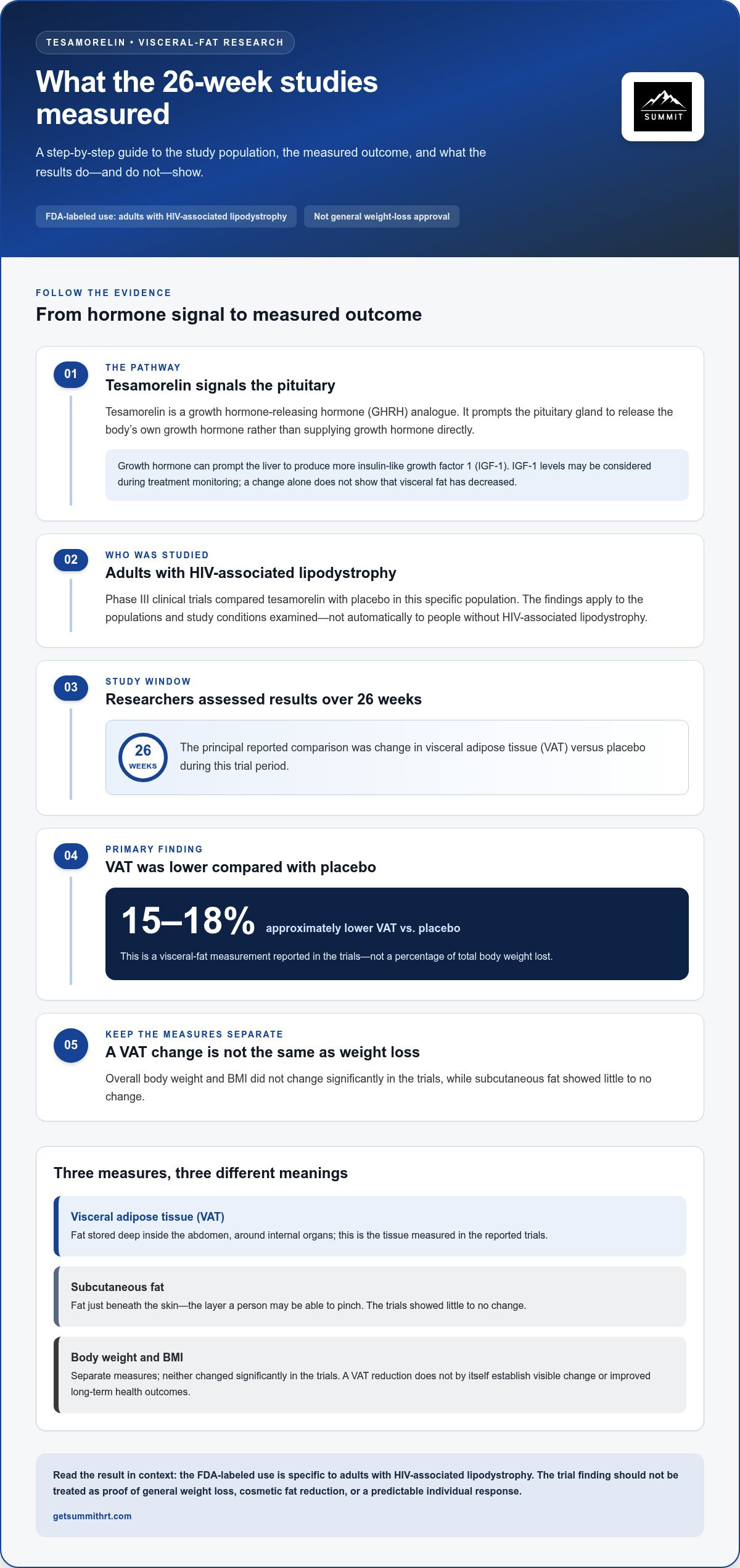
The phrase can sound like a promise to shrink any abdominal fat, but that’s broader than the evidence and approved use support. Tesamorelin is a growth hormone-releasing hormone (GHRH) analogue. It prompts the pituitary gland to release the body’s own growth hormone rather than supplying growth hormone directly. For a general overview of the medicine and its uses, see Tesamorelin.


What is visceral fat, and how is it different from belly fat?


Visceral adipose tissue is fat stored deep inside the abdomen, around internal organs. Subcutaneous fat sits just beneath the skin and is the layer a person may be able to pinch. Both can contribute to abdominal size, but they are different tissues. Total body weight is different again: it reflects the combined weight of fat, muscle, bone, organs, and fluid.


Appearance alone can’t show how much visceral fat someone has. A prominent abdomen isn’t a reliable way to distinguish deep abdominal fat from subcutaneous fat or other causes of abdominal size. This matters because research measuring visceral adipose tissue doesn’t automatically show that a treatment will change visible belly fat, body weight, or overall health outcomes.


What is tesamorelin approved to treat?


In the United States, FDA labeling specifies tesamorelin to reduce excess abdominal fat in adults with HIV-associated lipodystrophy. That is a defined medical indication, not approval for general weight loss, cosmetic fat reduction, or treating visceral fat in people without HIV-associated lipodystrophy. The indication describes the population and treatment goal; it doesn’t mean every person in that group is an appropriate candidate.


Use outside the labeled indication is considered off-label. Online claims that present tesamorelin as a broadly proven solution for stubborn belly fat go beyond what FDA approval establishes. Off-label prescribing is a clinical decision, not evidence that a treatment is suitable for everyone or will produce a particular result.


Keep the distinction clear: tesamorelin’s FDA-labeled use is specific, and it shouldn’t be treated as a shortcut for general weight management. Approval also doesn’t guarantee an individual response or establish that treatment will prevent complications or improve long-term health outcomes. A clinician can interpret the indication alongside your medical history, goals, and relevant test results before discussing whether a treatment approach makes sense.


How tesamorelin works, and what visceral-fat research can show


Tesamorelin acts on a hormone signal, not directly on fat cells. It is a synthetic analogue of growth hormone-releasing hormone (GHRH), which signals the pituitary gland to release the body’s own growth hormone. That pathway helps explain why studies examine changes in visceral adipose tissue, but it can’t predict how any one person will respond.


How does tesamorelin affect the growth hormone pathway?


After tesamorelin stimulates growth hormone release, growth hormone can prompt the liver to produce more insulin-like growth factor 1 (IGF-1). IGF-1 is a hormone involved in growth and other body processes. Clinicians may consider IGF-1 levels during treatment monitoring because they reflect activity in this pathway. A change in IGF-1, however, doesn’t by itself show that visceral fat has decreased or that treatment is appropriate. For additional patient-focused context, see Tesamorelin patient information.


What do clinical studies measure when they report fat reduction?


In phase III clinical trials involving adults with HIV-associated lipodystrophy, researchers compared tesamorelin with placebo and measured visceral adipose tissue (VAT). Over 26 weeks, tesamorelin reduced VAT by approximately 15% to 18% compared with placebo. This finding applies to the populations and study conditions examined; it shouldn’t be assumed to predict results in people without HIV-associated lipodystrophy.


VAT is assessed as a body-composition outcome rather than inferred from a change on the scale. Overall body weight and BMI did not change significantly in the trials, while subcutaneous fat showed little to no change. A measured reduction in deep abdominal fat therefore isn’t the same as losing a particular amount of weight, seeing a smaller waist, or proving improved long-term health.


A visceral-fat measurement can show a change in the amount of deep abdominal fat assessed, but it can’t alone establish visible change, overall weight loss, or better health outcomes. Keep that distinction in mind when weighing claims about tesamorelin for visceral fat reduction. If you’re considering whether the evidence applies to your circumstances, a clinician-led review can put your goals, medical history, and relevant lab results in context. Explore a clinician-led evaluation.


Tesamorelin benefits, limits, and risks: how to compare the evidence


Evidence is easiest to interpret when the measured outcome, studied population, and treatment risks stay in view. The FDA-approved indication is narrow, and a change in visceral fat should not be mistaken for general weight loss or proof of better cardiovascular health.


What benefits are supported, and what remains uncertain?


Clinical trials support a reduction in visceral adipose tissue in adults with HIV-associated lipodystrophy. That finding doesn’t establish that tesamorelin will reduce abdominal fat in everyone, change pinchable subcutaneous fat, or produce a meaningful change in scale weight or appearance. Nor does a VAT reduction by itself prove that treatment prevents heart attacks, improves cardiovascular risk, or extends life. Those are separate outcomes that require their own evidence.


Use the comparison below to distinguish what the evidence and labeling address from broader claims about tesamorelin for visceral fat reduction.


Which risks and monitoring questions matter?


The current FDA prescribing information contraindicates tesamorelin in people with active malignancy, disruption of the hypothalamic-pituitary axis, or pregnancy. A history of malignancy calls for careful consideration; clinicians also weigh the label’s warning about malignancy and monitor as appropriate. Other reported effects include joint pain, tingling sensations, and hypersensitivity reactions. This list isn’t a personal risk assessment.


Before making treatment decisions, review your medical history, medications, glucose-related risks, and any prior pituitary or cancer history with a qualified clinician. Ask what monitoring is appropriate, including whether glucose and IGF-1 should be followed in your situation. Bloodwork can inform that discussion, but it doesn’t establish that tesamorelin is suitable or make off-label use equivalent to an FDA-approved indication.


Tesamorelin for visceral fat reduction


How to assess whether tesamorelin fits your situation


A thoughtful discussion starts with your health context, not a search term or a promise of targeted fat loss. Tesamorelin’s labeled indication and the population studied matter, so a clinician needs to consider your diagnosis, goals, medical history, and potential risks together.


What should a clinician review before discussing treatment?


Bring a current medication list and a summary of relevant health conditions, past diagnoses, and treatment history. Be specific about what you hope to change. Reducing a measured visceral-fat level, losing overall weight, and changing your appearance are different goals, and the available evidence may not address them in the same way.


Use this four-step framework to organize the conversation:


  • Clarify your goal: Describe the outcome you’re seeking and how you hope to measure it.

  • Review your history: Discuss diagnoses, current and past medications, and any relevant pituitary, cancer, pregnancy, or glucose-related concerns.

  • Assess relevant labs: Comprehensive bloodwork can help inform an individualized medical review. Results don’t prove eligibility or establish that tesamorelin is appropriate.

  • Weigh options and follow-up: Discuss alternatives, possible risks, monitoring expectations, and how a clinician would evaluate response over time.


A clinician should compare your situation with the current prescribing information, including the labeled indication, contraindications, warnings, and precautions. That review should account for your personal risk profile rather than rely on a checklist that claims to determine treatment suitability.


What questions help compare tesamorelin with other approaches?


Clear questions can help you distinguish a supervised medical decision from generalized marketing claims. Consider asking:


  • How does this option relate to my diagnosis, and how closely does the research population match my circumstances?

  • What outcome would treatment aim to change, and how would we assess it without treating scale weight or appearance as a substitute for visceral-fat measurements?

  • Which risks and side effects are most relevant to my health history, and what monitoring would be appropriate?

  • What other approaches fit my goals, and what are their expected benefits and limitations?


For broader context on clinician-guided peptide discussions and individualized weight-management care, read Summit’s peptides for weight loss guide. If you’re ready to discuss your goals, medical history, and lab results in a clinician-led setting, explore a telehealth consultation.


Plan a clinician-led next step with Summit Rejuvenation


A sound next step is to confirm what tesamorelin is intended to treat, weigh the evidence and risks, and discuss how your health history shapes the decision. The question isn’t simply whether tesamorelin for visceral fat reduction is being discussed online. It’s whether the available evidence and treatment considerations fit your individual clinical context.


What happens during a personalized medical evaluation?


At Summit Rejuvenation, a telehealth consultation gives you space to discuss your health goals, relevant diagnoses, medications, and concerns with a clinician. Comprehensive bloodwork can add useful context to that conversation. Neither a consultation nor lab results automatically establish that a specific medication is appropriate; they support a fuller, individualized review.


Treatment planning should account for potential benefits and limitations alongside safety considerations and the current prescribing information. You can discuss what outcome matters to you, what monitoring may be relevant, and what follow-up would help assess the plan. The goal is not a universal protocol, but a decision informed by your circumstances.


How can readers make an informed decision after the consultation?


Before settling on a plan, make sure you understand the clinical rationale, what the proposed approach is meant to address, and what it can’t promise. Clarify any recommended monitoring, how response would be reviewed, and what would prompt a change in direction. A medically informed plan may or may not include tesamorelin.


For additional context on peptides and how they fit into broader health discussions, explore Summit’s peptide therapy guide. The aim is clarity, thoughtful follow-up, and care shaped around your health, not a guaranteed fat-loss outcome.


Explore personalized medical care with Summit Rejuvenation through a clinician-led telehealth consultation, comprehensive bloodwork, and personalized treatment planning.


Make your next step an informed one


Tesamorelin has a specific FDA-approved use, and evidence of reduced visceral fat in that setting doesn’t establish it as a general weight-loss treatment or guarantee an individual result. Keep the distinction between visceral fat, visible abdominal fat, and overall body weight in mind as you weigh treatment claims.


The best next step is a clinician-led discussion of your goals, health history, potential risks, and what monitoring may involve. Comprehensive bloodwork can help inform personalized planning, but it doesn’t determine suitability on its own. A telehealth consultation can bring those details together and support a considered conversation about options.


At Summit Rejuvenation, personalized medical planning and telehealth consultations serve patients nationally. You don’t have to make sense of broad claims alone. Explore personalized medical care with Summit Rejuvenation and take an informed step toward care that reflects your individual health needs.


Frequently Asked Questions


Is tesamorelin FDA-approved for visceral fat reduction?


Yes, but its FDA-labeled use is specific: reducing excess abdominal fat in adults with HIV-associated lipodystrophy. That approval doesn’t establish tesamorelin as a general weight-loss treatment or mean it’s suitable for everyone with visceral fat. Whether the indication applies depends on a person’s diagnosis and clinical circumstances. Discuss your health history and treatment options with a qualified clinician rather than relying on broad online claims.


Can tesamorelin help people lose weight without HIV-associated lipodystrophy?


Evidence from adults with HIV-associated lipodystrophy shouldn’t be assumed to apply to people outside that studied population. Research has measured changes in visceral fat, which is not the same as overall weight loss. Use outside the FDA-labeled indication is off-label, and that alone doesn’t show it’s appropriate for an individual. A clinician should weigh the available evidence, personal risks, goals, and alternatives before any treatment decision.


How does tesamorelin affect visceral fat?


Tesamorelin is a growth hormone-releasing hormone analogue that signals the pituitary gland to release the body’s own growth hormone. Researchers have assessed changes in visceral adipose tissue in specific study populations. Those measurements don’t automatically demonstrate a lower number on the scale, a visible change in abdominal shape, or better long-term health outcomes. The phrase tesamorelin for visceral fat reduction should be understood in that evidence-specific context.


What are the main risks or side effects of tesamorelin?


Reported side effects include joint pain, fluid retention, injection-site reactions, and tingling sensations. FDA labeling also warns that tesamorelin may impair glucose control, so glucose-related risks require clinician review and monitoring. The medication is contraindicated in people with active malignancy, disruption of the hypothalamic-pituitary axis, or pregnancy. This overview can’t assess personal safety. Discuss your medical history with a clinician, and seek urgent care for severe or concerning symptoms.


Does tesamorelin reduce belly fat or overall body weight?


Studies have found reductions in visceral fat in adults with HIV-associated lipodystrophy, but that doesn’t promise visible belly-fat loss or a specific change on the scale. Visceral fat lies around abdominal organs; subcutaneous fat sits beneath the skin. They’re distinct measures. Trial findings in a defined population can’t predict an individual response, and a change in visceral-fat measurement alone doesn’t establish improved long-term health.


What should I discuss with a clinician before considering tesamorelin?


Discuss your diagnosis, treatment goals, medical history, current medications, relevant bloodwork, possible risks, and expected monitoring. Ask how closely the available evidence fits your circumstances and how a clinician would evaluate response over time. Comprehensive bloodwork can inform individualized planning, but it can’t establish eligibility by itself. An online article can help you prepare, but it can’t determine whether treatment is appropriate or replace a personalized medical consultation.

NATIONWIDE TELEHEALTH

SUMMIT IS IN ALL 50 STATES

Expert hormone therapy and weight loss care - wherever you live.

Follow

  • Instagram
  • Facebook


Our Clinic Locations:

​

MISSOURI

​

FLORIDA

  • 11915 Beach Boulevard - Ste 116, Jacksonville, FL 32246
    (904) 481-5090

​

CONTACT

summitrcenters@gmail.com

© 2026 Summit Rejuvenation. All rights reserved.
Content, including images, displayed on this website is protected by copyright laws. Downloading, republication, retransmission, or reproduction of content on this website is strictly prohibited.

Terms of Use | Privacy Policy

bottom of page