Is TRT Worth It for Quality of Life? Benefits, Trade-Offs, and How to Decide
What if the right question isn’t simply whether TRT can raise testosterone, but whether it could improve the parts of daily life that matter to you? If you’re wondering, “is trt worth it for quality of life,” it’s understandable to want a clear answer before taking on ongoing treatment.
Low energy, changes in mood, reduced sex drive, and other concerns can affect how you feel, but symptoms alone don’t confirm that testosterone is the cause. TRT may help some people with a confirmed testosterone deficiency, yet results vary. Treatment can also involve follow-up, monitoring, possible side effects, and a long-term commitment.
This article will help you weigh potential quality-of-life benefits against those demands, understand what TRT can’t guarantee, and consider why a careful evaluation matters. We’ll look at how symptoms and bloodwork inform the decision, what questions to raise with a qualified clinician, and how to define meaningful progress for you. The goal isn’t to push you toward treatment or away from it. It’s to help you make an informed decision based on your health, priorities, and the potential net benefit.
Table of Contents
Is TRT worth it for quality of life? Start with the question that matters
How diagnosis and expectations shape TRT's quality-of-life value
TRT benefits versus trade-offs: compare the whole quality-of-life picture
A practical framework for deciding whether TRT is worth discussing
When to take the next step: personalized TRT evaluation with Summit Rejuvenation
Is TRT worth it for quality of life? Start with the question that matters
TRT may improve quality of life for some men with appropriately diagnosed testosterone deficiency, but improvement isn’t guaranteed. Whether it’s worthwhile depends on whether treatment addresses concerns that matter to you and whether potential benefits outweigh its demands. Quality of life is personal: it might mean having energy for the workday, feeling more emotionally steady, sleeping better, enjoying sexual well-being, or managing everyday tasks with less difficulty.
So, is trt worth it for quality of life? Symptoms can guide a conversation, but they don’t establish testosterone deficiency or show on their own that TRT is appropriate. A clinician considers symptoms alongside relevant blood tests and your health history. A low result or a list of symptoms also can’t promise that treatment will restore a particular feeling or change every part of your day. For general background on treatment and its effects, see this overview of Androgen replacement therapy.
What does a meaningful quality-of-life improvement look like?
Start by naming two or three concerns that affect you most. Be specific: instead of “more energy,” you might want to get through your usual afternoon routine without feeling depleted. Instead of “better sleep,” you might focus on how rested you feel in the morning. These examples help clarify your goals, not predict what TRT will do.
Record how those concerns affect your daily function before making a decision. Then ask a clinician how to track them over time and review whether any change is meaningful to you. Comparing progress with your own baseline is more useful than expecting a broad, guaranteed transformation.
Why a low-energy day does not answer the TRT question
Fatigue and mood changes can have multiple possible causes. One difficult day, or even a persistent symptom, can’t identify testosterone as the cause without medical assessment. Sleep patterns, other health conditions, medications, and lifestyle are useful topics to raise with a clinician, not clues you need to interpret or diagnose by yourself.
Bring a clear account of what you’ve noticed, when it occurs, and how it affects your routine. A clinician can consider that context alongside appropriate testing and your health history. This keeps the decision grounded in your individual situation instead of assuming that every nonspecific symptom points to low testosterone or will respond to TRT.
How diagnosis and expectations shape TRT's quality-of-life value
A useful TRT decision starts with more than a lab number. A clinician considers your concerns, health history, and relevant laboratory results together. This broader view helps assess whether testosterone deficiency may explain your symptoms and whether treatment is worth discussing. One result by itself can’t predict how you’ll feel or whether TRT will improve your day-to-day life.
Symptoms give test results context, and test results give symptoms context. Neither should be treated as a complete answer on its own. If you’re asking is trt worth it for quality of life, specific goals can make the assessment more practical. For example, you might discuss whether you hope to notice a change in a particular symptom or in your ability to manage a daily activity.
What should a clinician assess before discussing TRT?
Be ready to describe what you’ve noticed, when it began, and how it affects your routine. Share relevant health conditions and medications, along with the priorities you’d want treatment to address. A clinician can review this history alongside laboratory findings and determine whether testing should be repeated or supplemented. You don’t need to interpret a result or decide on a treatment threshold by yourself.
Summit Rejuvenation’s men's TRT care is informed by comprehensive bloodwork and personalized telehealth consultations. This can support an individualized discussion, while the clinician’s evaluation remains central to deciding whether TRT is appropriate. For broader background on treatment, explore this comprehensive TRT therapy guide.
Set expectations around benefits and uncertainty
Before considering treatment, separate the changes you hope to assess from outcomes no one can promise. A symptom-specific goal, such as seeing whether a concern that affects your routine changes, is more useful than expecting a guaranteed shift in appearance, athletic performance, or mood. Response and the time needed to evaluate it can vary, so ask the clinician how progress would be reviewed and what would count as meaningful for you.
It’s also reasonable to ask how possible benefits should be weighed against treatment demands and potential long-term risks. Harvard Health Publishing offers a cautious discussion of testosterone therapy’s risk-and-benefit questions. The goal isn’t to assume the worst or expect a cure, but to make an informed decision with your clinician.
If you’d like to explore whether an individualized TRT assessment may be relevant to your concerns, learn about Summit Rejuvenation’s men’s TRT care.
TRT benefits versus trade-offs: compare the whole quality-of-life picture
To judge whether TRT might be worthwhile, look at the whole experience, not just the possibility of symptom relief. A goal such as feeling more engaged in daily activities may matter more to you than a change in appearance or exercise performance. Potential benefits aren’t universal, and treatment shouldn’t be framed as a way to reverse aging or optimize everyone. A review of the benefits and risks of testosterone therapy can provide broader context, but your clinician should help interpret how that information applies to you.
Use the comparison below to identify what you’d want to discuss and track. It isn’t a prediction of your individual response.
Potential gains: focus on the symptoms that matter to you
Rank your symptom priorities before considering treatment. You might place energy first, sexual well-being second, and mood third, or choose different goals altogether. This makes later conversations more specific: instead of asking whether TRT will make you feel “better,” you can discuss which change you hope to notice and how you’ll assess it. Treat broad promises about youth, appearance, or performance as uncertain, not guaranteed outcomes.
What could make the trade-off feel less worthwhile?
Uncertain benefit, unwanted effects, follow-up, and the practical demands of treatment all belong in the decision. Ask the clinician which side effects and health considerations are relevant to your history, what monitoring may involve, and how treatment goals will be reviewed. Discuss fertility plans before starting, since testosterone therapy can affect sperm production. Don’t change or stop prescribed treatment without discussing it with your clinician.
Monitoring isn’t fine print. It’s part of weighing whether possible gains remain meaningful over time. Ultimately, the answer to is trt worth it for quality of life depends on how potential changes compare with the health considerations and ongoing commitment in your particular case.
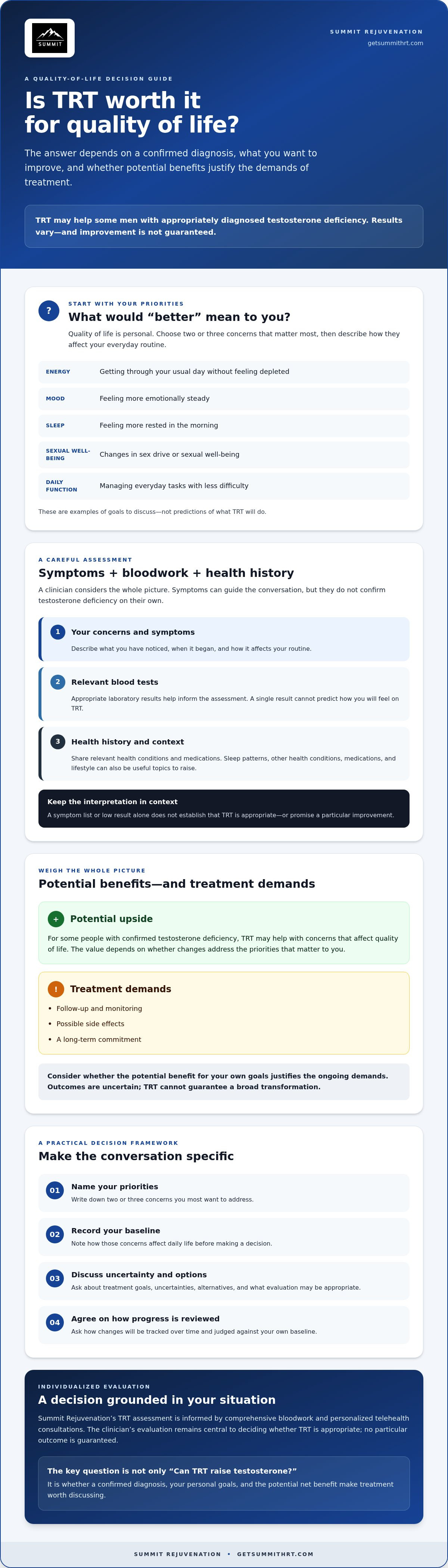
A practical framework for deciding whether TRT is worth discussing
You don’t need to arrive at a consultation knowing whether you want TRT. Start with a clear account of what’s affecting you, then use the discussion to understand whether the evidence supports considering treatment and how you’d evaluate its value.
Document your concerns. Note the symptoms that matter most, when they occur, and how they affect daily life.
Seek an individualized assessment. Discuss your symptoms, health history, and relevant test results with a qualified clinician.
Agree on meaningful goals. Choose specific changes you’d want to assess rather than relying on a general promise to feel younger.
Weigh benefits and trade-offs. Ask about uncertainty, possible side effects, relevant alternatives, and the demands of treatment and follow-up.
Plan a review. Before starting any treatment, clarify how you and your clinician would discuss progress, tolerability, and next steps.
This sequence can turn “is trt worth it for quality of life” into a more useful conversation about your diagnosis, priorities, and what would count as a worthwhile result for you.
Questions to bring to a TRT consultation
Bring questions that invite a clear explanation, not just a yes-or-no answer:
How do my symptoms and test results support, or not support, a diagnosis?
Would testing need to be repeated or supplemented before making a decision?
Which changes are realistic to assess in my situation, and what remains uncertain?
What follow-up and monitoring may apply, and what alternatives should we consider?
For a general outline of what the process may involve, see this step-by-step TRT process. Use it as background for your discussion, not as a substitute for personal medical guidance.
How to judge whether the plan is helping
Use the priorities you recorded before treatment as your reference point. If your main concern was having enough energy to manage a regular routine, track that concern and any changes that feel relevant. Keep notes on unwanted effects or new concerns, too, and bring both kinds of observations to follow-up discussions. Avoid judging success against a vague expectation of feeling younger.
Ongoing review helps you and your clinician assess whether potential benefits are meaningful and treatment remains tolerable. Agree in advance on how progress will be discussed. The timing and approach should be determined with your clinician based on your circumstances.
If you’re ready to discuss whether an individualized assessment may fit your concerns, explore Summit Rejuvenation’s men’s TRT care, informed by comprehensive bloodwork and telehealth consultations.
When to take the next step: personalized TRT evaluation with Summit Rejuvenation
If you have symptoms that affect daily life and want to understand whether testosterone could be relevant, an evidence-informed assessment can help clarify the question. That doesn’t mean TRT is automatically appropriate. It means bringing your concerns to a qualified clinician who can consider the available information and discuss what it does, and doesn’t, support.
What an individualized evaluation can clarify
Summit Rejuvenation’s men’s TRT care uses comprehensive bloodwork and personalized telehealth consultations to inform treatment planning. Bloodwork is one input, not proof of a predetermined diagnosis or a promise that treatment will be recommended. A useful conversation can include your symptoms, personal priorities, relevant health history, and questions about uncertainty. Telehealth offers an access option, but it doesn’t replace appropriate medical evaluation or follow-up.
To make the discussion more focused, consider bringing:
A brief record of the symptoms that concern you and how they affect daily function.
Your main priorities, including what changes would feel meaningful to you.
Relevant health history, medications, and questions about potential benefits, risks, or alternatives.
Ask what the available findings suggest, whether additional assessment is needed, and what follow-up may involve if treatment is considered. Details should be discussed with the clinician based on your individual circumstances.
Explore the next step without assuming TRT is right for you
The decision framework is straightforward: consider whether your symptoms merit discussion, whether the assessment supports a diagnosis, and whether potential benefits align with your goals and outweigh the treatment demands for you. Keep uncertainty in the picture. An evaluation can help explain options and open questions, but it doesn’t guarantee eligibility, a recommendation for TRT, or a particular result.
If you’re still asking, is trt worth it for quality of life, you don’t need to decide before learning more. A personalized discussion can help you understand how your concerns and bloodwork inform the next steps, including whether TRT is appropriate to consider. The choice remains yours, made with clinical guidance and realistic expectations.
To explore whether an individualized assessment fits your needs, learn about Summit Rejuvenation’s men’s TRT care.
Make your next TRT decision with clarity
Whether is trt worth it for quality of life depends on more than a hope for more energy or better well-being. Symptoms need to be considered alongside appropriate testing and health history, and any possible benefit should be weighed against uncertainty, side effects, and the commitment to follow-up.
Start with the changes that matter most to you. Set realistic, symptom-specific goals with a qualified clinician, then agree on how you’ll review progress and tolerability. A thoughtful assessment can help clarify whether TRT is appropriate to discuss, but it can’t guarantee eligibility or a particular outcome.
Summit Rejuvenation uses comprehensive bloodwork to inform personalized treatment planning and offers telehealth consultations. Prescribed medication delivery is available within service areas. These options can support an informed discussion, while the right next step depends on your individual assessment.
If you’re ready to explore your questions without assuming TRT is the answer, discuss your goals with Summit Rejuvenation. A clear, personalized conversation can help you decide what makes sense for your health and priorities.
Frequently Asked Questions
Is TRT worth it for quality of life?
TRT may be worthwhile for some men with appropriately assessed testosterone deficiency and relevant symptoms, but outcomes vary. The question “is trt worth it for quality of life” depends on your priorities, the changes you hope to assess, and whether potential benefits justify trade-offs such as side effects, treatment demands, and follow-up. Symptoms alone or one lab result can’t promise improvement or establish that TRT is right for you. Discuss your situation with a qualified clinician rather than self-diagnosing.
Can TRT improve energy, mood, or motivation?
Some people may notice changes in symptoms they’ve discussed with a clinician, but TRT doesn’t guarantee better energy, mood, or motivation. These concerns can also have causes unrelated to testosterone. Describe when your symptoms occur, how they affect your routine, and any relevant health context, then review appropriate testing with your clinician. Before treatment, agree on which changes to track and how you’ll assess them during follow-up, including any concerns or unwanted effects.
How long does it take to know whether TRT is helping quality of life?
There’s no universal timeline for knowing whether TRT is helping, because response and the time needed to assess it vary. You and your clinician can agree on when to review your symptoms, relevant tests, treatment goals, and tolerability. Keep a simple record of meaningful changes and concerns between appointments. That gives you more useful information to discuss than relying on one unusually good or difficult day to judge your experience.
What happens if TRT does not improve my symptoms?
If symptoms persist, follow up with your clinician rather than assuming you need more treatment. Together, you can revisit the original assessment, discuss your response and any unwanted effects, and consider other possible explanations for what you’re experiencing. Your next steps should reflect that review and your individual health context. Don’t change or stop prescribed treatment on your own. Speak with the clinician who prescribed it before making treatment decisions.
Is TRT a lifelong commitment?
TRT isn’t automatically a lifelong commitment for every person, but decisions about continuing, changing, or stopping treatment depend on individual circumstances. Discuss duration and ongoing monitoring with your clinician rather than assuming you can stop without consequences. Before starting, ask how your goals will be reviewed, what follow-up may involve, and what a future reassessment would consider. This conversation helps you understand the commitment before deciding whether treatment fits your priorities.
Can I start TRT based on symptoms alone?
No. Symptoms matter, but they don’t establish a testosterone deficiency or show by themselves that TRT is appropriate. A qualified clinician considers your health history and appropriate testing, and may discuss whether other explanations deserve attention. Seek an individualized assessment instead of relying on another person’s symptoms, online advice, or one isolated test result. Sharing how your concerns affect daily life can help make that discussion more relevant to your situation.
What should I ask a clinician before starting TRT?
Ask how your symptoms and test results support a diagnosis, which changes are realistic to assess, and what uncertainties remain. Discuss possible risks, alternatives, follow-up, and monitoring relevant to your circumstances. Share fertility goals, existing health conditions, and medications so the clinician can consider your broader context. This is a shared decision, not a commitment to treatment. A responsible evaluation may conclude that TRT isn’t appropriate for you.


Comments